Have you ever thought about how trainers can teach cooperative care to alligators, lions, bears, and so many other animals, but for some reason some people still push the idea that there are some dogs that require a heavy hand?
Whatever your thoughts are about zoos, it's worth sitting with that for a moment. In zoos and aquariums around the world, keepers ask animals who could genuinely hurt them, animals with jaws that can crush bone and instincts honed over millions of years, to voluntarily participate in their own care. Crocodiles present their tails for blood draws. Lions hold their mouths open for dental cleanings. Bears station calmly for injections. Giraffes stand still for hoof work. Nobody is forcing them. Nobody is hurting them. And nobody in their right mind would try to "dominate" a lion with a collar correction.
So why, when it comes to an animal who has spent tens of thousands of years evolving alongside us, an animal whose entire survival strategy is cooperation with people, do we keep hearing that some dogs just need a firmer hand?
These alligators were taught to come, stay, and more with force-free training.
How Cooperative Care Works With Animals Who Could Eat You
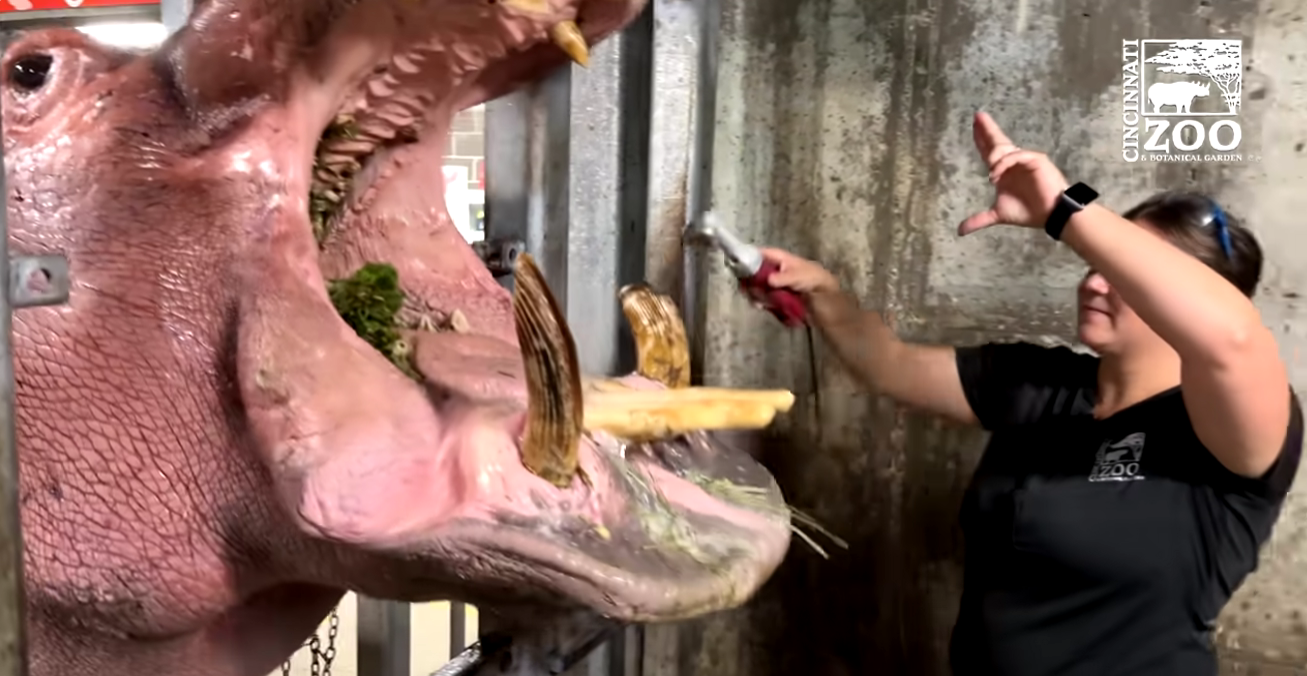
The methods zoo professionals use aren't exotic secrets. They're the same principles that modern, force-free dog trainers use every day: positive reinforcement, choice, clear communication, and trust. The animal learns that a specific behavior like holding still, presenting a body part, or stepping onto a scale predicts something good. If they're uncomfortable, they can opt out. And remember: a lot of this training is done with protected contact, meaning the animal is behind a barrier, so the trainer is not touching the animal at all.
Why? Not just because it would be dangerous (though it would). It's because punishment and force don't work any better on a lion than they do on a leash-reactive dog. Aversive methods create fear, defensive aggression, and broken trust. When the animal you're working with weighs 400 pounds or more, you simply cannot afford to damage the relationship. Zoo trainers learned decades ago what the research on companion animals now confirms: cooperation built on trust is stronger, safer, and more reliable than compliance built on fear.
Think about what that means. If gentle, reward-based training is effective enough to draw blood from a crocodile, trim the nails of a bear, and medicate a sea lion, animals with no evolutionary history of taking direction from humans, then the idea that a domesticated dog "needs" pain, force, or fear to learn isn't just outdated. It's backwards.
A side-by-side comparison makes the point better than words can. On the left, a crocodile voluntarily presenting for a blood draw. On the right, a dog doing the exact same thing.
A crocodile voluntarily presenting for a blood draw, The Sydney Zoo
A dog doing the exact same thing, Anna Wong
Where the "Heavy Hand" Myth Comes From
The belief that some dogs require a heavy hand comes from an old, debunked model of animal behavior: the idea that dogs are constantly competing with us for rank, and that we must assert dominance or lose control. That theory was built on flawed studies of captive wolves in the mid-20th century, studies whose author later retracted his own conclusions. Wild wolf packs, it turns out, are families (parents and pups), not dominance hierarchies constantly fighting for the top spot.
Misunderstood wolf behavior is often referred to as the reason for using punitive training with dogs.
The myth survives anyway, because it offers a simple story for complicated behavior. A dog who lunges, growls, or pulls isn't "challenging" anyone. They're communicating, often fear, frustration, pain, or an unmet need. As I've written about before, behavior is frequently a symptom of physical discomfort. A "stubborn" dog may be hurting. A "defiant" dog may be terrified. A heavy hand doesn't resolve any of that. It silences it, and silence isn't the same as safe.
"But My Dog Is Different": Is He?
This is usually where the conversation goes: "That works for Labs and Goldens, but my dog is a [fill in the blank], a Malinois, a Cane Corso, a shelter dog with a bite history. He needs a heavier touch."
Here's the thing. The principles of learning, how consequences shape behavior, how emotions drive responses, how trust enables cooperation, are the same across every breed, every size, and every history. A dog's breed may influence what motivates them and how quickly they arousal escalates. It does not change how learning works. In fact, the dogs who are labeled "difficult", the strong ones, the intense ones, the ones with big feelings, are the ones who have the most to lose when we use force, because their reactions to pain and fear are bigger, too.
Zoo trainers work with animals whose "breed" is literally apex predator, and they succeed without force. The difference isn't the animal. It's the method and the mindset.
What Cooperative Care Looks Like for Dogs
The beautiful part is that cooperative care isn't just for zoos. It's one of the most practical gifts you can give your own dog, and it uses the same skills:
Teaching a 150 lb Sun Bear to cooperate with nail trims.
Teaching a 100 lb German Shepherd with a history of trauma around his nails to cooperate with nail trims.
- Voluntary participation. Teaching your dog to step into the car, onto the scale at the vet, or into the bathtub on a cue they've learned to trust, and letting them say "not yet" without penalty.
- Body-handling skills. Building a "chin rest" or "station" behavior so nail trims, ear cleaning, and grooming become something your dog does with you instead of something done to them.
- Choice and consent. Watching for the small signals (a head turn, a lip lick, a lean away) that say "I need a moment," and honoring them before they have to escalate.
- Teaching, not suppressing. Instead of punishing the growl, the lunge, or the struggle, asking what the behavior is communicating and addressing the cause.
When dogs learn these skills, the "heavy hand" becomes unnecessary, not because anyone is being permissive, but because the dog has actual skills and a relationship built on trust and kindness with the person. That's what cooperation looks like. It's also what most people wanted all along: a dog they can live with, communicate with, and take anywhere.
The Question Worth Asking
So the next time someone tells you that some dogs need a heavy hand, ask yourself: if keepers can teach a crocodile to volunteer for a blood draw and a lion to open their mouth for a dental cleaning, what exactly is it about a dog, an animal that has evolved to bond with us, to want to work with us, that would require pain, force, or fear?
The answer is nothing. No dog needs a heavy hand. Some dogs need more skill, more patience, more management, sometimes a veterinary behaviorist, and almost always more understanding than we were taught to give. But a heavy hand? That was never a requirement. It was just an old habit, one we're finally, dog by dog, learning to let go.
Looking for support that's grounded in kindness and built on trust? Tell me about your dog, and we'll build a force-free plan together.
Get new posts in your inbox
Compassionate, practical guidance for life with your dog — delivered when new articles are published. No spam, unsubscribe anytime.
The information in this article is educational and is not a substitute for individualized dog-training, behavior, or veterinary advice. Contact a qualified veterinarian regarding questions about your dog’s health or physical comfort.